Creating a 2027 Vision Board: How to turn it into a video that makes an impact (for free with Canva)
Published on 24 October 2026
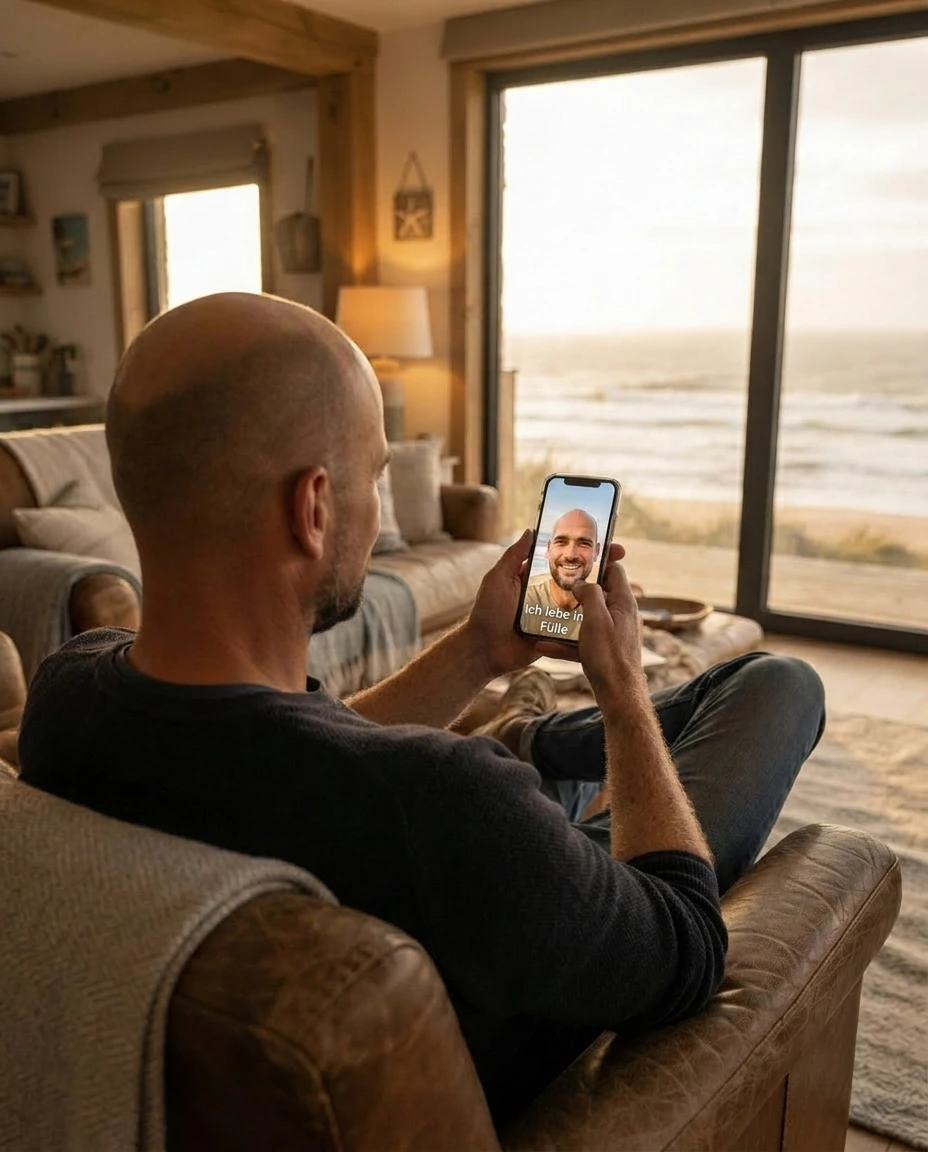
A new year is just around the corner. Perhaps you’re sitting at your desk right now with some magazines, a pair of scissors and some glue, or scrolling through Pinterest and collecting images for your 2027 vision board. That’s a lovely start.
In this post, I’ll show you how to take your vision board one step further: by creating a short video featuring your images, your music and your wishes and goals, as if you’d already achieved them. It’s free, using Canva, step by step.
Latest news: My Vision Movie Programme starts on 2 November. Over four weeks, you’ll create your own Vision Movie, with support from a small group. There are still places available. Click here to view the offer.
Why a vision board on its own is often not enough
A vision board is a picture of your future. You hang it up, look at it and visualise yourself in that future.
Or perhaps you’ve experienced this too: after a few weeks, it’s still hanging in the same spot. Only you don’t notice it any more. It’s become an inconspicuous part of your wall.
It was exactly the same for me. The board was there, but it just didn’t do it for me anymore. What I was missing was movement, music and a set time of day when I could really get into it.
From a vision board to a vision film
A vision film is a vision board in motion. It’s a short film, just a few minutes long, featuring images and short video clips that illustrate your goal. Overlaid on these are sentences in the present tense, as if it were already a reality: ‘I live by the sea.’ “I feel whole.” Whatever you like. Accompanied by music that moves you.
The idea is not new. It became known as ‘Mind Movie’, a term coined by the Australians Natalie and Glen Ledwell in 2007. I have developed it into my own format and call it ‘Vision Movie’.
The difference compared to the board: you watch the film deliberately, in the mornings and evenings or at times that best suit your daily routine. It draws you in with music and movement. And it becomes a ritual rather than just a decoration on your wall.
What happens in your brain when you visualise your goal
Sounds a bit like New Age mumbo jumbo? There’s actually some fascinating research on this.
In the 1990s, the neurologist Alvaro Pascual-Leone had one group practise a sequence of notes on the piano, whilst a second group practised the same sequence purely in their imagination. In both groups, the same areas of the brain responsible for finger movement underwent changes.
The principle behind this is called neuroplasticity: whatever you repeat over and over again leaves traces in your brain. This includes things you visualise vividly. It’s not exactly the same as real-life experience, but it’s measurably similar.
This is exactly where a vision film comes in. It brings your vision to life with images, music and emotion. And it ensures that you revisit it every day.
Create a 2027 vision board as a video: step by step with Canva
All you need is a free Canva account, your own images and about two hours.
1. Work out what you really want. Not what sounds good, but what feels right to you. A career, a relationship, health, a place, a feeling. Write down three to five goals.
2. Write your sentences as if it has already happened. Not ‘I want more peace and quiet’, but ‘I am calm and clear-headed’. Keep it short, in the present tense, and in your own words.
3. Collect pictures and short video clips. These can be your own photos, images from free databases or from your existing vision board. The only important thing is that, when you look at them, something clicks inside you – a positive feeling.
4. Choose your music. A song you can listen to over and over again. If you hear it on the radio later, the feeling you had whilst watching your film will come flooding back, and you’ll strengthen the connection to your future without even realising it.
5. Structure your film into five parts:
Important: all video segments must be the same length (at least 2 mins)
- Part 1: Kaleidoscope with calm, trance-like music
- Part 2: your photos with your captions, accompanied by your favourite music
- Part 3: Kaleidoscope with soothing music
- Part 4: your photos with your captions, accompanied by your favourite music
- Part 5: Kaleidoscope, this time with your favourite music
6. Just create it in Canva (the free version is fine).
Open a new video, upload images, clips and music, and drag them onto the timeline. You can find kaleidoscope videos in the Canva library or on free video portals. Add your text over the images.
7. Export your video as an MP4 and save it to your mobile. That way, you’ll always have it to hand and can watch it whenever you’re bored ;)
A note about the music: You can use any song you like for personal use.
How to watch your Vision Movie
In the morning, straight after waking up, and in the evening, before going to sleep. At these times, your mind is calmer and the images have a deeper effect. But if other times of day feel more natural to you, that’s fine too. Give it a go.
When using the kaleidoscope, I’d recommend looking towards the centre with a soft focus, without focusing on anything in particular. I always go over to it beforehand and take 10 deep breaths in and out through my nose. That’s the easiest way for me to switch off. Try out whatever feels right for you, or leave a comment if you need some advice. There are plenty of techniques out there – you’re bound to find one that suits you ;)
And then: feel it. Don’t just look at it – feel what it’s like when it’s already here. Try to feel a positive emotion, such as love, gratitude, freedom, a sense of adventure, invincibility or boundlessness. What positive emotion will you feel when your future has caught up with you? Through constant repetition, the emotion becomes increasingly palpable.
What usually causes it to fail
Making a vision film is the easy bit. The hard bit is sticking with it. After two weeks, you run out of time. Or doubts start to creep in: is this actually achieving anything?
That’s exactly why I developed my Vision Movie Programme. In the first week, we’ll create your video together over three evenings. After that, I’ll support you for three weeks in a small group:
• We’ll discuss what’s already becoming clear.
• We’ll look at things together when doubts arise.
• You’ll receive encouragement to keep going.
By the end, you’ll not only have your own film, but also the knowledge of how to make the most of it on your own. You can find the Vision Movie Programme on my website under ‘Services’.
The next round starts on 2 November. A maximum of 12 places.
Click here to access my Vision Movie Programme.
Frequently Asked Questions
What is the difference between a vision board and a vision film?
A vision board is a picture; a vision film is a film featuring movement, music and text. You watch it mindfully every day, rather than simply hanging up a picture.
Is a Vision Movie the same as a Mind Movie?
The idea is the same. Mind Movie is the name by which it became known. Vision Movie is my own format, which comes with accompanying material.
Can I create a vision film for free?
Yes. The free version of Canva is all you need.
How long should the video be?
10 minutes is a good guideline. Long enough to make an impact, short enough for every day.
When should I create my 2027 vision board?
Whenever you’re ready. The start of a new year is a lovely occasion, but you don’t have to wait for it. Especially if you feel that you want more out of life.
0 comments
No comments yet. Be the first to post one!